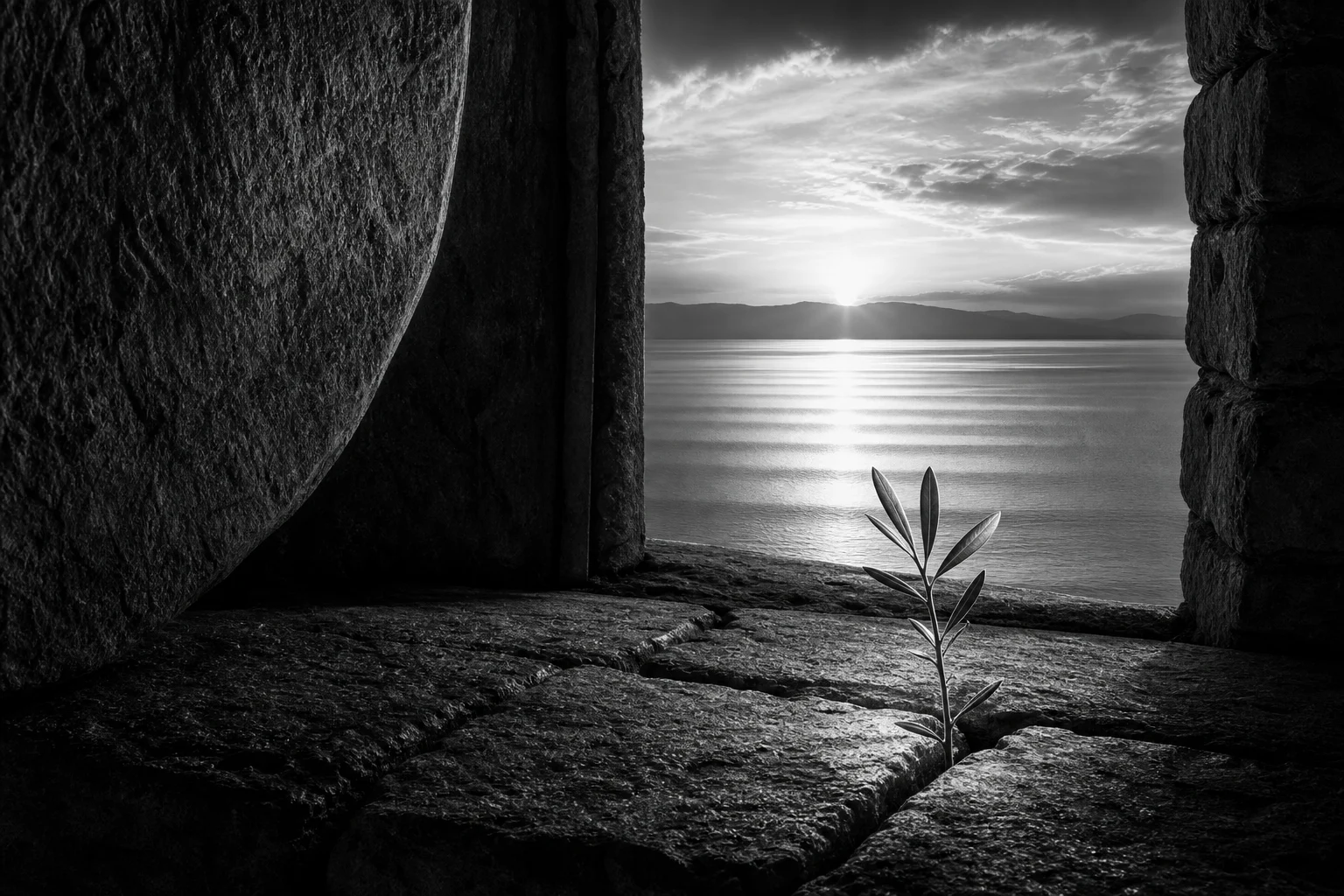
Eight is the number of new beginnings — the day after seven, the start of a new cycle. It represents resurrection, regeneration, and the fresh start that comes from God's completed work.
The number 8 often marks a new stage after a completed cycle. Eight people leave the ark into a remade world, covenant circumcision occurs on the eighth day, and Christians associate resurrection with the first day of the new week. The new-beginning theme is well supported. It still needs textual discipline, not generic “fresh start” projection.
If seven is completion, then eight is what comes after completion — the new beginning. It is the number of resurrection, regeneration, and supernatural fresh starts. Eight breaks through the boundary of the old cycle and inaugurates something entirely new. It is not the continuation of the old — it is the birth of what has never existed before.
Eight Survivors of the Flood
When the entire old world was judged and destroyed, exactly eight people survived on the ark: Noah, his wife, his three sons, and their wives (1 Peter 3:20; Genesis 7:13). These eight stepped off the ark into a brand new world. Everything before the flood was over. The old civilization, the old corruption, the old patterns — all washed away. Eight was the number of the new beginning.
Peter makes the connection explicit: "In it only a few people, eight in all, were saved through water, and this water symbolizes baptism that now saves you also — not the removal of dirt from the body, but the pledge of a clear conscience toward God" (1 Peter 3:20-21). Eight connects directly to baptism — the sacrament of new beginnings, dying to the old and rising to the new. The flood account also sits inside Scripture's wider pattern of forty-day testing that prepares the ground for renewal.
Circumcision on the Eighth Day
God commanded that every male child be circumcised on the eighth day (Genesis 17:12; Leviticus 12:3). Why the eighth? Because circumcision was a sign of the covenant — a cutting away of the old to enter into something new. The eighth day represents covenant initiation beyond the natural week. It is the supernatural day — the day that exists outside the seven-day creation framework established before the Sabbath's completed rest.
Modern medicine has confirmed the wisdom of the eighth day: a newborn's vitamin K and blood-clotting prothrombin levels peak on the eighth day of life, making it the safest day for the procedure. God's numeric instructions were medically precise millennia before science understood why.
Jesus Rose on the "Eighth Day"
Jesus rose from the dead on Sunday — the first day of the new week, but also the eighth day counting from the previous Sunday. The resurrection was the ultimate eighth-day event: the old creation's death cycle was broken, and a new creation began. Paul captures this in 2 Corinthians 5:17: "If anyone is in Christ, the new creation has come; the old has gone, the new is here!"
This is why the early church gathered on Sunday — the "eighth day" — rather than Saturday. They were not merely changing their day of worship; they were declaring that a new creation had begun. The seventh-day rest pointed forward to what the eighth day accomplished: the end of death's reign and the beginning of resurrection life.
The Eighth Day of the Feast of Tabernacles
The Feast of Tabernacles (Sukkot) lasted seven days — but God added an eighth day called Shemini Atzeret (Leviticus 23:36, 39). This eighth day was a separate, solemn assembly — distinct from the seven-day feast. The rabbis called it the day when God says, "Stay with me one more day."
It was on this very day — the "great day of the feast" — that Jesus stood and cried out: "Let anyone who is thirsty come to me and drink. Whoever believes in me, as Scripture has said, rivers of living water will flow from within them" (John 7:37-38). On the eighth day of the feast, Jesus proclaimed the new beginning: the outpouring of the Holy Spirit.
David: The Eighth Son
When Samuel came to Jesse's house to anoint the next king, Jesse presented seven sons — and God rejected all seven. Samuel asked, "Are these all the sons you have?" Jesse answered, "There is still the youngest" — David, the eighth son (1 Samuel 16:10-12).
Seven sons were passed over. The eighth was chosen. The pattern is clear: God's choice often lies beyond what the natural order presents. Eight is the number that says: what you see isn't all there is. God has something beyond the seventh option — something no one was looking for.
Eight Beatitudes
Jesus pronounced eight blessings in the Beatitudes (Matthew 5:3-10) — the opening charter of the Kingdom of God. Not seven (completion of the old), but eight — the inauguration of the new kingdom ethic. The Beatitudes are the new creation's values: blessed are the poor in spirit, those who mourn, the meek, those who hunger for righteousness, the merciful, the pure in heart, the peacemakers, and the persecuted. Eight kingdom values for the new kingdom age.
Eight in Hebrew: Super-Abundance
The Hebrew word for eight is shemoneh (שְׁמוֹנֶה), which is related to the root shamen, meaning "to make fat" or "to super-abound." Eight is the number of super-abundance — more than enough, overflowing beyond the complete. When God gives an eighth, He is giving more than full measure.
When eight appears, take heart: God is opening a new chapter. The old cycle has completed. What is emerging is not a repetition of the past — it is something genuinely new. Consider:
What old thing has ended? — Eight requires the completion of seven first. Something had to finish before the new could begin
What is being born? — Eight is not renovation — it is creation. Something that has never existed is coming into being
Are you being called into covenant? — Circumcision on the eighth day was covenant entry. Is God initiating something new with you?
Is resurrection power at work? — Eight is the number of what rises from death. What looked dead is coming alive
Eight is the number of resurrection power applied to your circumstances. The tomb is empty. The old creation is behind you. Step into the new — it has never existed before, and it is waiting for you on the eighth day.
Peter recalls the eight people saved through water and links that event to baptism.
Observation
Eight is attached to a genuine scriptural new-start pattern, not merely later symbolism.
Genesis 17:12
Context
Covenant circumcision is commanded on the eighth day.
Observation
The sign of covenant membership arrives after the first completed week of life.
Leviticus 23:36,39
Context
The Feast of Booths includes an eighth-day solemn assembly.
Observation
Eight can mark a distinct continuation beyond a complete seven-day feast.
Lexical or mathematical evidence
Lexical and mathematical checks
Genesis 7:13
8 people
Noah, his wife, his three sons, and their wives.
Genesis 17:12
8th day
Covenant initiation for male infants.
John 20:26
After eight days
A resurrection appearance is narrated with explicit eight-day language in many translations.
Worked examples and tables
Eight as beyond the completed week
The textual thread is not that eight is magical, but that eight often names a renewed stage after a completed prior order.
Reference
Count
Note
Genesis 7:13
8 people
Noah, his wife, his three sons, and their wives.
Genesis 17:12
8th day
Covenant initiation for male infants.
John 20:26
After eight days
A resurrection appearance is narrated with explicit eight-day language in many translations.
Interpretive alternatives
Interpretive alternatives
New beginning after completed order
High
Flood, circumcision, and feast texts make the new-stage reading of eight straightforward. Eight is repeatedly attached to transition after a completed cycle. It does not mean any modern eight automatically predicts a divine restart.
Resurrection and new creation symbolism
Moderate
Christian theology often reads Sunday and resurrection as an eighth-day reality beyond the old week. This is a coherent canonical and liturgical development. The symbolism depends on broader theological synthesis, not on a single verse saying “eight means resurrection.”
Confidence label
What is firm and what stays bounded
High
High
Flood, circumcision, and feast texts make the new-stage reading of eight straightforward. Eight is repeatedly attached to transition after a completed cycle.
It does not mean any modern eight automatically predicts a divine restart.
Secondary reading: Christian theology often reads Sunday and resurrection as an eighth-day reality beyond the old week.