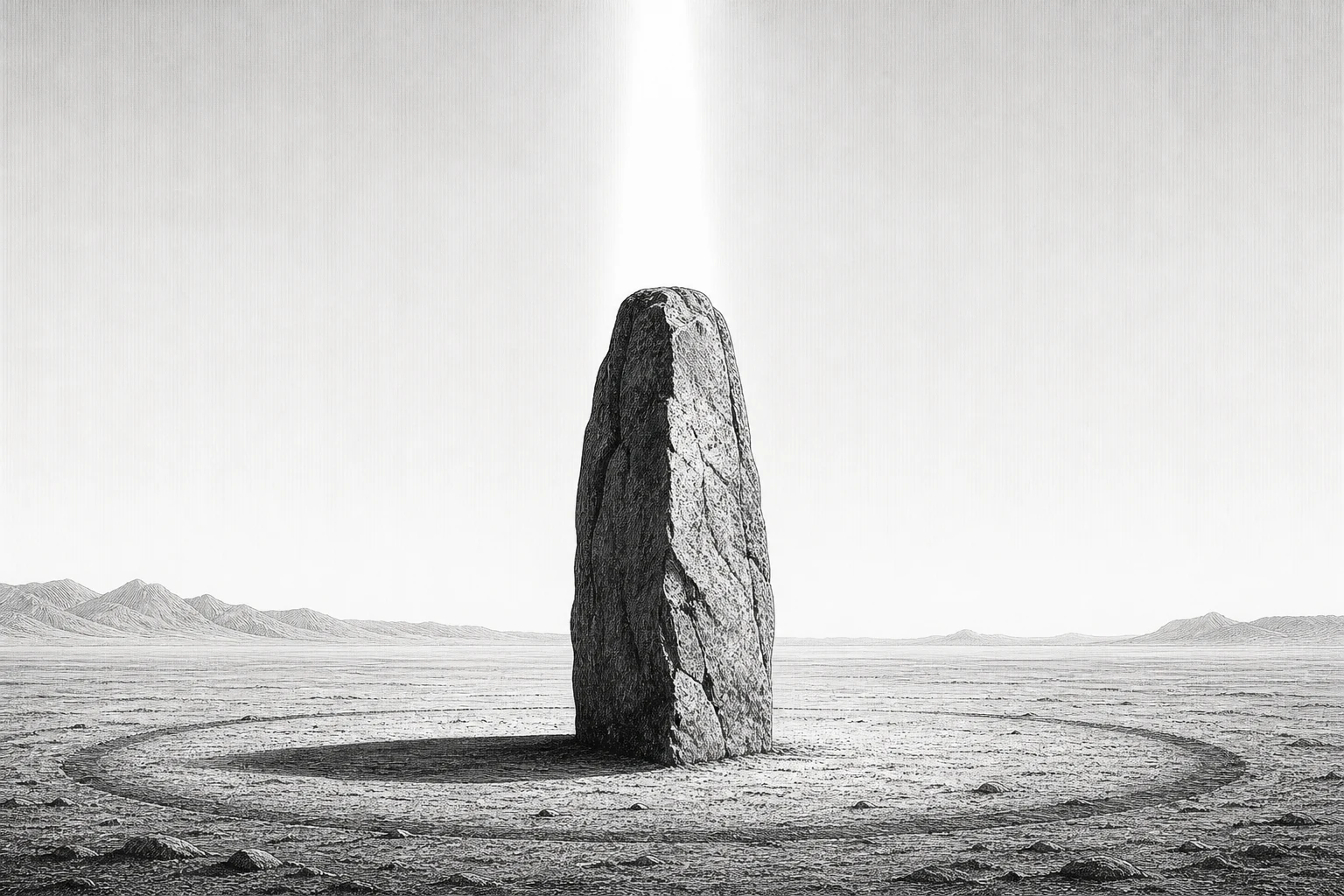
The Number 1: God's Absolute Unity and Sovereignty
The number one is the foundation of all numbers and all of reality. In Scripture, it represents the absolute unity, sovereignty, and primacy of God — the One from whom all things flow.
The number 1 in Scripture most clearly marks God as one, unrivaled, and first. Deuteronomy 6:4, Isaiah 45, and Ephesians 4 use oneness to name God’s unique identity and the unity that flows from Him. The text supports monotheism with high confidence; broader Trinitarian synthesis comes from the canon as a whole, not this number alone.
Before there was two, before there was many, there was One. The number 1 in Scripture is not merely a quantity — it is a theological declaration. It is the number of God's absolute unity, His unrivaled sovereignty, and His singular supremacy over all creation. To understand the number 1 is to stand at the foundation of everything the Bible reveals about who God is.
The Shema: Hear, O Israel
The most foundational confession in all of Judaism — and arguably in all of Scripture — is the Shema of Deuteronomy 6:4: "Hear, O Israel: The LORD our God, the LORD is one." The Hebrew word used here is echad (אֶחָד), and its meaning runs far deeper than simple arithmetic.
Echad does not merely mean "one" in the sense of a solitary unit. It carries the sense of a compound unity — a oneness that can contain plurality. This is the same word used in Genesis 2:24 when a man and woman become "one flesh" (basar echad). Two distinct persons, unified into one. This is critical: the very first number in Scripture already contains the seed of the Trinity — a unity that is not simple but profound.
If the writers of Scripture wanted to express absolute, solitary oneness, they could have used the word yachid (יָחִיד), which means "only, unique, solitary" — the word used of Isaac as Abraham's "only son" in Genesis 22:2. But God is described as echad, not yachid. This linguistic choice is theologically loaded: God is one in unity, not one in isolation.
First Mention: Genesis 1:5
The principle of "first mention" — the idea that a word or concept's first appearance in Scripture sets its thematic trajectory — gives us a powerful lens. The number one first appears in Genesis 1:5: "And there was evening, and there was morning — the first day."
On this first day, God performed the most fundamental act of creation: He separated light from darkness. The number 1, then, is immediately associated with beginnings, primacy, and the sovereign initiative of God. God did not consult. He did not collaborate. He spoke, and light existed. One is the number of uncaused action.
Notice also that the Hebrew text uses an unusual form: not yom rishon (the first day) but yom echad (day one). Rabbinical scholars have noted this distinction — God did not say "the first of many." He said "day one" — a singular, unique day unlike any other, because on this day, God alone existed as creator with no creation yet beside Him. Day one stands alone, just as God stands alone.
One God, One Lord, One Faith
The apostle Paul echoes this numeric theology in Ephesians 4:4-6: "There is one body and one Spirit... one Lord, one faith, one baptism; one God and Father of all." Seven times Paul uses the word "one" in three verses — and seven, as we explore in our study of the number 7, is the number of completion. The sevenfold repetition of "one" is not accidental. It declares that God's unity is complete, total, and all-encompassing.
This sevenfold declaration of oneness also reveals the scope of what God's unity covers:
One body — unity in the Church
One Spirit — unity in spiritual life
One hope — unity in destiny
One Lord — unity in authority
One faith — unity in belief
One baptism — unity in initiation
One God and Father — unity in origin
Every dimension of Christian existence is governed by oneness. There is no area of life where divided loyalty is acceptable.
The Prophetic Weight of One
When the number 1 appears in prophetic contexts, it often signals:
God's singular purpose — He has one plan, not many. "For I know the plans I have for you" (Jeremiah 29:11) — plans, singular in Hebrew (machashavot — thoughts/plans that converge toward one outcome)
Primacy and preeminence — Christ as the "firstborn over all creation" (Colossians 1:15), the "Alpha" (Revelation 22:13), the one who is "before all things" (Colossians 1:17)
Undivided loyalty — "No one can serve two masters" (Matthew 6:24). The number 1 demands exclusive devotion
The starting point — Every prophetic journey begins at one. Before multiplication, before fruit, before the fullness — there is the single seed planted in the ground
One in the Old Testament Patterns
The number 1 carries weight throughout the Old Testament narrative:
One ark saved all of humanity — not two boats, not a fleet, but one ark (Genesis 6-8)
One nation chosen through one man — Abraham, through whom all nations would be blessed (Genesis 12:1-3)
One tabernacle — the singular dwelling place of God among His people (Exodus 25:8-9)
One Day of Atonement per year — the one day when the high priest entered the Holy of Holies (Leviticus 16)
One bronze serpent — lifted up for the healing of an entire nation (Numbers 21:8-9)
The pattern is consistent: God works through one to accomplish what affects many. The singular becomes the source of the plural.
The Gematria of Aleph
In Hebrew, the letter aleph (א) has a gematria value of 1. Aleph is the first letter of the alphabet, the beginning of all language and communication. It is also the first letter of several foundational Hebrew words: El (God), Elohim (God in His fullness), Emet (truth), and Echad (one). The very structure of Hebrew language places God — the One — at the beginning of everything. The letter aleph is also traditionally written as two yods connected by a vav, which some scholars interpret as two divine fires connected by a bridge — another hint at compound unity.
Explore the numeric values of these names and more with our Gematria Calculator.
One in Your Life
When the number 1 shows up in your life — whether in dreams, in recurring patterns, or in moments of divine alignment — ask yourself:
What is God calling me to begin? — One is the number of new initiatives and first steps
Where is He asserting His singular lordship? — What area of life is He claiming as exclusively His?
What area of divided loyalty is He addressing? — Are you trying to serve two masters?
What seed is being planted? — One seed, one word, one act of obedience — this is where multiplication starts
The number 1 is an invitation back to the foundation. Before complexity, before multiplication, before the fullness of God's numeric language unfolds — there is the One. And everything starts there. As Jesus Himself declared: "The most important commandment is this: 'Hear, O Israel: The Lord our God, the Lord is one'" (Mark 12:29). Return to the One, and everything else finds its proper order.
Israel’s covenant confession identifies the LORD as Israel’s God and names Him as one.
Observation
The passage establishes covenant monotheism before any later symbolic reading of the number.
Isaiah 45:5-6
Context
The LORD contrasts Himself with every rival deity before the nations.
Observation
Oneness here functions as exclusive sovereignty, not as a numerology exercise.
Ephesians 4:4-6
Context
Paul stacks seven uses of “one” to describe the church’s shared life under God.
Observation
The passage ties divine oneness to ecclesial unity and shared confession.
Lexical or mathematical evidence
Lexical and mathematical checks
אחד
echad
Common term for one; used in Deuteronomy 6:4 and Genesis 2:24.
יחיד
yachid
Word for only or solitary; often used for an only son or unique one.
Sevenfold “one” in Ephesians 4:4-6
Body, Spirit, hope, Lord, faith, baptism, God and Father.
Worked examples and tables
Key Hebrew distinction in the oneness discussion
The lexical evidence supports the biblical language of oneness; it does not by itself settle every later doctrinal debate about divine unity.
Term
Transliteration
Note
אחד
echad
Common term for one; used in Deuteronomy 6:4 and Genesis 2:24.
יחיד
yachid
Word for only or solitary; often used for an only son or unique one.
Sevenfold “one” in Ephesians 4:4-6
Body, Spirit, hope, Lord, faith, baptism, God and Father.
Interpretive alternatives
Interpretive alternatives
Covenant monotheism and divine exclusivity
High
The strongest reading is that one names God’s uniqueness, primacy, and unshared sovereignty. The passages clearly establish that Israel’s God is not one option among many. They do not reduce every later use of one to a hidden symbolic code.
Canonical Christian reading of unity fulfilled in Trinitarian doctrine
Moderate
Christians often read Deuteronomy 6:4 together with Matthew 28:19 and John 17 to say the canon’s one-God language coheres with Father, Son, and Spirit. This is a legitimate canonical synthesis when later texts are allowed to interpret earlier ones. Deuteronomy 6:4 alone does not present a full Nicene formulation.
Confidence label
What is firm and what stays bounded
High
High
The strongest reading is that one names God’s uniqueness, primacy, and unshared sovereignty. The passages clearly establish that Israel’s God is not one option among many.
They do not reduce every later use of one to a hidden symbolic code.
Secondary reading: Christians often read Deuteronomy 6:4 together with Matthew 28:19 and John 17 to say the canon’s one-God language coheres with Father, Son, and Spirit.