If there is a single number that defines the architecture of Scripture, it is seven. Appearing over 700 times in the Bible, the number 7 is the numeric signature of God's perfect, completed work. It is the number of covenant, of rest, and of spiritual wholeness. No other number in the biblical canon appears with such frequency, such consistency, or such theological weight.
The Number 7: Spiritual Perfection and Completion
Seven is the most significant number in all of Scripture. It represents spiritual perfection, divine completion, and the covenant rhythm of God. No number appears more frequently or more powerfully.
Answer first
What the biblical evidence supports
The number 7 is the Bible’s clearest number for completion, consecrated rest, and covenant fullness. Genesis 2 grounds it in God’s finished work, and later texts extend that pattern through festivals, oaths, and Revelation. The completion theme is strongly textual. Personal claims about “perfect sevens” still need context and should not outrun the passage.
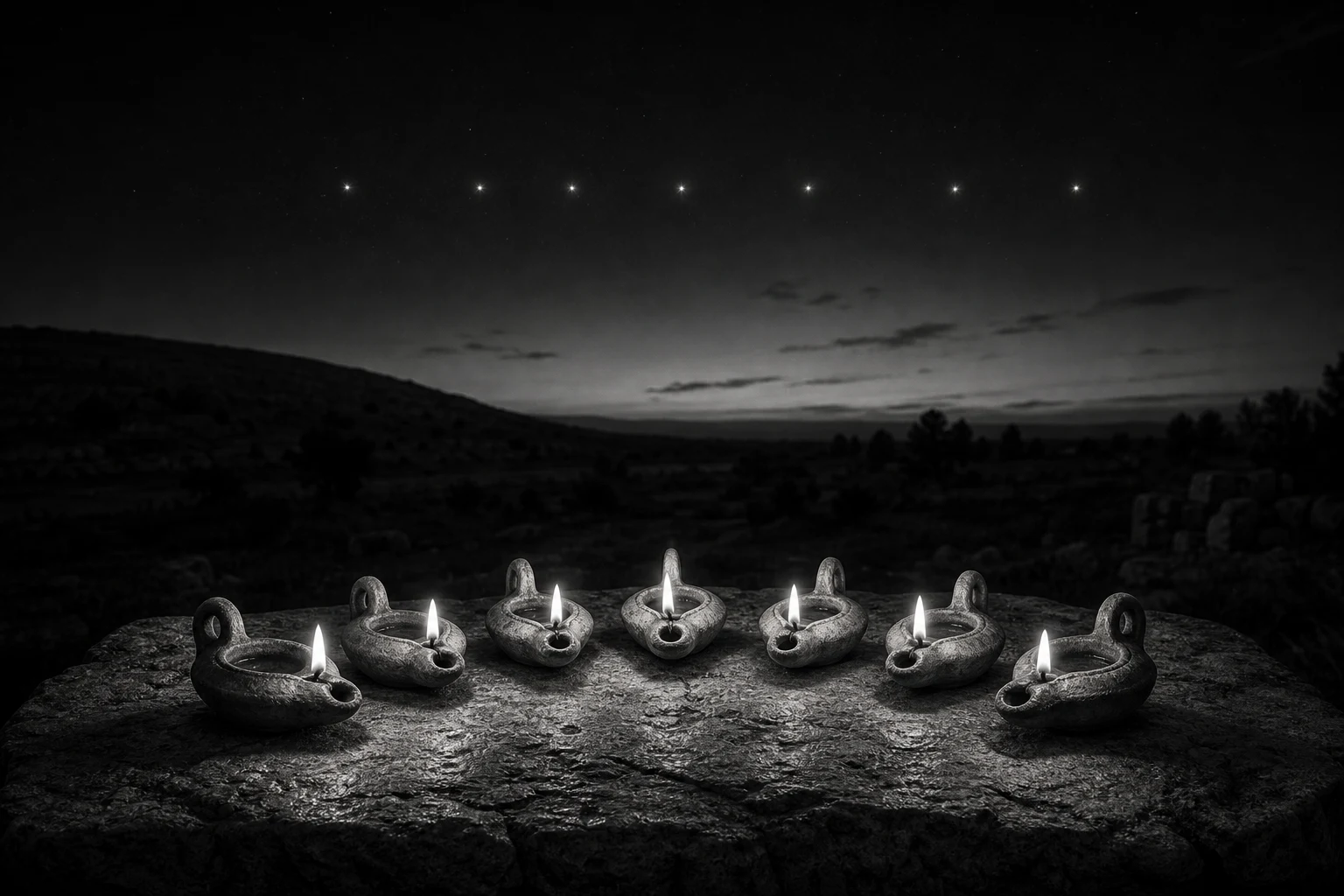
The Foundation: Creation Week
The number 7 is established in the very first chapter of Scripture. God created the heavens and the earth in six days and rested on the seventh (Genesis 2:2). This seventh day — the Sabbath — was not merely a day off. It was a declaration of completion. God's work was perfect, whole, lacking nothing. The seventh day was set apart (qadash — made holy), which means the number 7 is intrinsically linked to holiness and sanctification.
Notice the precision: God did not rest on the sixth day (human effort) or the eighth day (new beginnings). He rested on the seventh — because seven is the moment when divine work reaches its intended fullness. The creation week is the template for every seven-pattern in Scripture that follows.
The Hebrew Word: Sheva and Covenant
The Hebrew word for seven is sheva (שֶׁבַע), which shares its root with shava (שָׁבַע), meaning "to swear an oath" or "to make a covenant." This linguistic connection is profound: in Hebrew thought, to seven oneself is to bind oneself in covenant. Every time we encounter the number 7, we are encountering God's covenant faithfulness — His sworn, unbreakable commitment to His word.
Consider Beersheba (בְּאֵר שֶׁבַע) — literally "Well of the Oath" or "Well of Seven." In Genesis 21:27-31, Abraham gave seven ewe lambs to Abimelech as a witness to their covenant. The place was named Beersheba because there they swore an oath. Seven and covenant are linguistically and theologically inseparable in Hebrew.
Seven Throughout the Old Testament
The prevalence of 7 in the Old Testament is staggering:
- 7 days of creation (Genesis 1-2)
- 7 pairs of clean animals on Noah's ark (Genesis 7:2)
- 7 years Jacob worked for Rachel — then 7 more (Genesis 29:20, 27)
- 7 years of abundance followed by 7 years of famine in Pharaoh's dream (Genesis 41)
- 7 days Israel marched around Jericho, with 7 priests blowing 7 trumpets, marching 7 times on the seventh day (Joshua 6:4)
- 7 feasts of the Lord (Leviticus 23) — Passover, Unleavened Bread, Firstfruits, Pentecost, Trumpets, Day of Atonement, Tabernacles
- 7 branches of the Temple menorah (Exodus 25:37)
- 7 times Naaman dipped in the Jordan for healing (2 Kings 5:10)
- 7 times Elijah's servant looked for a rain cloud (1 Kings 18:43)
Every one of these sevens carries the same signature: God's work brought to its perfect, intended completion.
Seven in the New Testament
The pattern continues with equal intensity in the New Testament:
- 7 "I AM" statements of Jesus in John's Gospel — "I am the bread of life," "the light of the world," "the door," "the good shepherd," "the resurrection and the life," "the way, the truth, and the life," and "the true vine"
- 7 last words of Christ on the cross — a complete, finished message from the cross
- 7 deacons appointed in Acts 6:3 to serve the early church
- 7 parables in Matthew 13 — the complete kingdom teaching
- Peter asked if he should forgive 7 times; Jesus said seventy times seven (Matthew 18:21-22) — perfected, unlimited forgiveness
Jesus' use of seven was intentional. When He spoke seven "I AM" statements, He was declaring His complete, perfect identity. Nothing more needed to be said. Seven sealed it.
The Book of Revelation: Seven Amplified
Revelation is the crescendo of seven in Scripture. The number appears over 50 times in this single book:
- 7 churches receiving letters (Revelation 2-3) — representing the complete Church
- 7 spirits before God's throne (Revelation 1:4) — the complete Holy Spirit
- 7 lampstands (Revelation 1:12) — the complete witness
- 7 stars (Revelation 1:16) — the complete angelic authority over the churches
- 7 seals (Revelation 6-8) — the complete scroll of destiny
- 7 trumpets (Revelation 8-11) — the complete announcement of judgment
- 7 bowls of wrath (Revelation 16) — the complete outpouring of final judgment
- 7 thunders (Revelation 10:3) — mysteries so complete they were sealed
The structure of Revelation is built on three sets of seven judgments (seals, trumpets, bowls) — giving us 7 × 3 = 21 total judgments. Seven (perfection) multiplied by three (divine completeness) equals the total, complete, divinely perfect judgment of the earth.
The Mathematics of Seven
Seven is a prime number — it cannot be divided by anything other than itself and one. This mathematical property mirrors its theological meaning: God's perfection is indivisible. It cannot be broken down, factored, or reduced. It stands alone, complete in itself.
The gematria value of the Hebrew word for "sword" (cherev, חֶרֶב) is 210 = 7 × 30. The word for "the Sabbath" (ha-Shabbat) contains the letter values that reduce to a digit root of 7. Throughout the Hebrew language, seven echoes in words associated with completion, holiness, and covenant. Use our Gematria Calculator to explore these connections yourself.
Why Seven Matters for Spiritual Growth
Understanding seven transforms how you read Scripture. When you see a seven-pattern, you know God is declaring: "This is complete. This is perfect. This lacks nothing." It also explains why breaking the Sabbath was so serious in the Old Covenant — it wasn't about a day of the week. It was about rejecting the principle of divine completion and trying to achieve through human effort (six) what only God can provide through rest (seven).
The writer of Hebrews applies this directly: "There remains, then, a Sabbath-rest for the people of God; for anyone who enters God's rest also rests from their works, just as God did from his" (Hebrews 4:9-10). To enter seven is to enter rest from self-effort — trusting that God's work is already complete.
Seven in Your Prophetic Journey
When the number 7 appears — in seasons (7 years, 7 months), in repetition (seeing it everywhere), or in structure (7 steps, 7 confirmations) — recognize it as a signal that God is completing something. A cycle is closing. A covenant is being established. His perfect work is being finalized in your life.
Ask yourself these questions when seven appears:
- What is God completing? — Look for cycles reaching their end
- What covenant is being established? — Seven always connects to sworn promises
- Where am I being called to rest? — Seven is an invitation to stop striving
- What has reached its full measure? — Patience and the biblical pattern of testing and preparation reaching completion
Do not rush past seven. Rest in it. It is holy ground. The God who completed creation in seven days is completing His work in your life with the same precision, the same perfection, and the same unbreakable faithfulness.
If you want to keep reading, start with Biblical numbers, The Prophetic Number Code, and the complete library.
Biblical passages in context
Scripture in context
Genesis 2:2-3
Context
God completes His work, rests, blesses the seventh day, and makes it holy.
Observation
Completion and sanctified rest are explicit, not inferred.
Leviticus 23:15-16
Context
Israel counts seven full weeks toward Pentecost.
Observation
Seven structures sacred time beyond the creation week itself.
Revelation 1:4, 12-16
Context
John opens with seven churches and a sevenfold symbolic frame for the whole book.
Observation
Revelation deliberately amplifies seven as a book-level structuring number.
Lexical or mathematical evidence
Lexical and mathematical checks
שבע
sheva
Hebrew numeral for seven.
שבע
shava / shaba
Verb associated with swearing or taking an oath in covenant contexts.
Beersheba
be-er sheva
Genesis 21 links the place name with oath and seven ewe lambs.
Worked examples and tables
Hebrew covenant and seven vocabulary
| Term | Transliteration | Note |
|---|---|---|
| שבע | sheva | Hebrew numeral for seven. |
| שבע | shava / shaba | Verb associated with swearing or taking an oath in covenant contexts. |
| Beersheba | be-er sheva | Genesis 21 links the place name with oath and seven ewe lambs. |
Interpretive alternatives
Interpretive alternatives
Completion, holiness, and Sabbath rest
HighGenesis 2:2-3 gives the base meaning of seven with unusual clarity. The text explicitly establishes finished work, blessing, and sanctification. It does not promise that every seventh unit in later experience will signal divine approval.
Covenant fullness and liturgical structure
ModerateFestival counts, oath language, and Revelation’s design show seven functioning as a mature covenant-structure number across the canon. There is substantial textual support for this broader pattern. The pattern should remain subordinate to each book’s genre and immediate argument.
Confidence label
What is firm and what stays bounded
High
HighGenesis 2:2-3 gives the base meaning of seven with unusual clarity. The text explicitly establishes finished work, blessing, and sanctification.
- It does not promise that every seventh unit in later experience will signal divine approval.
- Secondary reading: Festival counts, oath language, and Revelation’s design show seven functioning as a mature covenant-structure number across the canon.
Source notes
Citations and reference points
- Genesis 2:2-3Primary passage in context.
- Leviticus 23:15-16Primary passage in context.
- Revelation 1:4, 12-16Primary passage in context.
- שבעHebrew numeral for seven.
- שבעVerb associated with swearing or taking an oath in covenant contexts.
- BeershebaGenesis 21 links the place name with oath and seven ewe lambs.
Study next
Related references and tools
Number 8 and the cycle beyond seven
Extends the rest-and-completion theme into resurrection and new creation.
Number 6 and human labor
Clarifies why six and seven are often read together rather than in isolation.
Number 40 and prolonged testing
Shows how long-form testing often resolves into completed divine work.
Related volume
The Prophetic Number Code
This completed guide is currently available for purchase.